




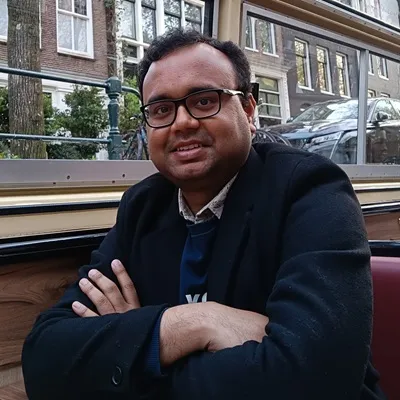
Dr. Mainak Das
Welcome to Functional Organic Materials Laboratory
We combine synthetic chemistry with advanced physical characterization to uncover how molecular structure dictates function. Our research centers on π-conjugated macrocycles and three-dimensional molecular frameworks, where topology, curvature, and redox activity give rise to unconventional electronic, optical, spin, and aromaticity properties. By revealing new structure–property relationships, we aim to establish the molecular foundations of next-generation functional materials.
Assistant Professor (2026- Present) : Indian Institute of Technology (IIT-BHU) Varanasi
Marie-Curie Postdoctoral research fellow (2025-2026) : Sorbonne University, France, Europe
Supervisor: Dr. Guillaume Vives
Postdoctoral research associate (2023-2025) : University of York, England, UK
Supervisor: Dr. Alyssa-Jennifer Avestro
Ulam NAWA Postdoctoral research fellow (2021-2023) : Jagiellonian University, Poland, Europe
Supervisor: Prof. Miłosz Pawlicki
Ph.D. in chemistry (2020): National Institute of Science Education and Research (NISER), Bhubaneswar, India
Supervisor: Prof. A. Srinivasan
M.Sc. in chemistry (2014): Jadavpur University, Kolkata, India
Supervisor: Prof. Shouvik Chattopadhyay
B.Sc. in chemistry (2012): Jadavpur University, Kolkata, India
Corresponding authorships are marked with *
23. R. Vishwakarma, Mainak Das* and A. Srinivasan*, Meso-Modified Porphyrinoids: Stimuli Driven Conformational Plasticity, Modulation of π-Conjugation, and Bis-Rh(I) Complexation. Inorg. Chem. 2026, 65, 149−155.
22. A. Kalaiselvan, C. K. Prasad, S. Sah, Mainak Das* and A. Srinivasan*, Nonalternant Acenaphthylene-Fused Carbaporphyrins: Topological Modulation of π‑Delocalization, (Anti)aromaticity, and BIII Coordination. Org. Lett. 2025, 27, 12076−12080.
21. R. Vishwakarma†, P. Gupta†, A. Behera, K. Mandal, Deepak Chopra*, Mainak Das* and A. Srinivasan*, Siamese Twin Homocarbaporphyrin Dimer: Nonplanar Architecture, Localized Conjugation and Bis-BIII Complex. Chem Asian J. 2025, 20, e00856. (†equally contributed).
20. R. Vishwakarma, D. Blasco, D. Sundholm*, N. Ch. Jana, Mainak Das* and A. Srinivasan*, E‑Stilbene-Imprinted Cyclic Diphyrin and Its BIII Complex. Org. Lett. 2025, 27, 6429−6433.
19. R. Vishwakarma, N. Ch. Jana, Mainak Das* and A. Srinivasan*, Twists and Loops: Exploring Lemniscular Vinylogous Benzioctaphyrin(2.0.1.0.2.0.1.0). Chem Asian J. 2025, 20, e202401548.
18. A. Kayal, S. R. Pradhan, C. K. Prasad, Mainak Das* and A. Srinivasan*, Dicarbatriphyrin(2.1.1) and its Carbacalix[1]phyrin Analogue: Structure-Property Relationships and Application as a Fe(III) Chemosensor. Chem Asian J. 2025, 20, e202401089.
17. S. R. Pradhan, C. K. Prasad, Mainak Das* and A. Srinivasan*, De novo Fabrication of Higher Arene Ring Incorporated Contorted Calix[2]phyrin(2.2.1.1.1) and Its F- Bound Complex. Dalton Trans. 2024, 53, 15258–15263.
16. S. R. Pradhan, C. K. Prasad, Mainak Das* and A. Srinivasan*, The (o-p-o)-Terphenyl Embedded Calix[2]phyrin(2.2.1.1.1) and Its Cu(II) Complex. Chem Asian J. 2024, 19, e202400135.
15. P. Banachowicz, Mainak Das, K. Kruczała, M. Siczek, Z. Sojka, M. Kijewska and M. Pawlicki*, Breaking Global Diatropic Current to Tame Diradicaloid Character: Thiele’s Hydrocarbon Under Macrocyclic Constraints. Angew. Chem. Int. Ed. 2024, 63, e202400780.
14. S. R. Pradhan, M. Murugavel, S. Chitranshi, G. Kim, D. Kim, Mainak Das* and A. Srinivasan*, Unveiling Protonated Form of 2,6-Di-m-phenylpyridine Embedded Isosmaragdyrin analogue and Its Organo-Pd(II) complex. New J. Chem. 2023, 47, 19987−19992.
13. Mainak Das* and A. Srinivasan*, Advent and Features of Pyriporphyrinoids: An Overview of a Pyridine Based Porphyrin Analogue. Chem. Commun. 2023, 59, 11780−11790.
12. S. Chitranshi†, B. Adinarayana†, Mainak Das, S. Anila, C. H. Suresh and A. Srinivasan*, Rh(I) and Organo-Rh(III) Complexes of meso-Triarylbiphenylcorrole. Inorg. Chem. 2023, 62, 336−341. (†equally contributed).
11. Mainak Das, B. Adinarayana and A. Srinivasan*, Recent Advances in the Design and Syntheses of Porphyrinoids by Embedding Higher Analogues of Arene and Pyridine Units. ACS Omega 2021, 6, 35204−35212.
10. Mainak Das, D. Singh, S. Chitranshi, M. Murugavel and A. Srinivasan*, N-Confused Pyritriphyrin: A New Class of Triphyrin and its Calixphyrin Analogue. Eur. J. Org. Chem. 2021, 5222−5226.
9. S. Chakraborty, Mainak Das, A. Srinivasan* and A. Ghosh*, Tetrakis-(N-methyl-4-pyridinium)-Porphyrin as a Diamagnetic Chemical Exchange Saturation Transfer (diaCEST) MRI Contrast Agent. New J. Chem. 2021, 45, 1262−1268.
8. M. Murugavel, B. Adinarayana, Mainak Das, S. Peruncheralathan, N. R. Palepu and A. Srinivasan*, PtCl2 Mediated Peripheral Transformation of Carbatriphyrin(3.1.1) into meso Fused β-βʹ Dimer and Its Monomer Analogue. Chem. Commun. 2020, 56, 12809−12812.
7. Mainak Das, S. Chitranshi, M. Murugavel, B. Adinarayana, C. H. Suresh and A. Srinivasan*, Isosmaragdyrin with an N3C2 core: stabilization of Rh(I) and organo-Pt(II) complexes. Chem. Commun. 2020, 56, 3551−3554.
6. S. Chitranshi†, Mainak Das†, B. Adinarayana, W.-Y. Cha, D. Kim and A. Srinivasan*, Structurally Isomerized Bis-Biphenyl Moieties Embedded in Hexaphyrin(3.1.1.3.1.1) and Octaphyrin(1.1.1.0.1.1.1.0). Org. Lett. 2020, 22, 1081−1085. (†equally contributed).
5. S. Chitranshi†, B. Adinarayana†, Mainak Das, W.-Y. Cha, D. Kim and A. Srinivasan*, Bis-4,4′-biphenyl Ring Embedded Octaphyrin with Three Distinct Conformational Structures. Chem. Eur. J. 2019, 25, 12911−12915. (†equally contributed) (Selected as Hot Paper).
4. Mainak Das, B. Adinarayana, M. Murugavel, S. Nayak and A. Srinivasan*, Di‑(m‑m‑m)terphenyl-Embedded Decaphyrin and Its Bis-Rh(I) Complex. Org. Lett. 2019, 21, 2867−2871.
3. B. Adinarayana, Mainak Das, C. H. Suresh and A. Srinivasan*, Homocarbaporphyrinoids: The m-o-m and p-o-p Terphenyl Embedded Expanded Porphyrin Analogues and Their RhI Complexes. Chem. Eur. J. 2019, 25, 4683−4687.
2. B. Adinarayana†, M. Murugavel†, Mainak Das, N. Rao Palepu and A. Srinivasan*, Rhodium(III) and Iridium(III) Bipyricorrole Complexes: Syntheses, Structures, and Properties. Inorg. Chem. 2018, 57, 1840−1845. (†equally contributed).
1. K. S. Anju†, Mainak Das†, B. Adinarayana, C. H. Suresh* and A. Srinivasan*, meso-Aryl [20]π Homoporphyrin: The Simplest Expanded Porphyrin with the Smallest Möbius Topology. Angew. Chem. Int. Ed. 2017, 56, 15667−15671. (†equally contributed).
PhD Positions
We are seeking motivated and creative students with a strong background in organic and supramolecular chemistry to join our newly established research group. We value intellectual curiosity, original thinking, and a passion for addressing challenging problems in molecular science. Prospective candidates holding a valid CSIR, UGC, or DST-INSPIRE PhD fellowship are especially encouraged to apply. Interested applicants are invited to contact mainak.chy@iitbhu.ac.in for information on current research opportunities.
Postdoctoral Positions
We are always interested in hearing from talented and highly motivated researchers with expertise in synthetic organic chemistry, nanoscience and supramolecular chemistry. Candidates who have recently completed, or are nearing completion of their PhD are encouraged to apply. Prospective postdoctoral researchers are expected to actively pursue external fellowship opportunities and contribute to a vibrant and collaborative research environment. Interested applicants are invited to contact mainak.chy@iitbhu.ac.in to discuss potential opportunities within the group.
How to Apply
Interested candidates are requested to submit the following documents via email:
• Cover Letter describing your motivation for applying, research interests aligned with the group's research activities, and long-term career goals.
• Curriculum Vitae (CV) including academic qualifications, research experience, publications, awards, and relevant skills.
• Academic Transcripts of undergraduate and postgraduate degrees.
• Ph.D. Degree Certificate or Provisional Degree Certificate (for postdoctoral applicants).
• Relevant Certificates (e.g., CSIR-NET, UGC-NET, GATE, fellowships, awards, or other academic distinctions).
• Research Summary highlighting previous research contributions and future research interests.
• List of Publications (if applicable).
• At least two Letters of Recommendation, to be sent directly by the referees/mentors to the contact email provided below.
Application Submission
Please send all application materials to:
📧 mainak.chy@iitbhu.ac.in
Applications will be reviewed on a rolling basis until the positions are filled.
Current Open Positions
The group is open to hosting candidates applying for the National Postdoctoral Fellowship (NPDF).
Eligibility
Applicants for the Postdoctoral Researcher position should hold a Ph.D. degree in a relevant field. Candidates who have recently completed their Ph.D. and are awaiting the award of the degree may also apply by providing a Provisional Degree Certificate or official proof of Ph.D. completion.
Seed Grant
Funding agency: IIT(BHU), Varanasi
Amount: ₹ 25,00,000
Status: Ongoing
- Marie Skłodowska-Curie actions (MSCA) Postdoctoral Fellowship
Funding agency: European Commission
Amount: 211,754.88 €
Status: Completed
Funding agency: The Polish National Agency for Academic Exchange (NAWA)
Amount: 252,000 PLN
Status: Completed
- Member of the Royal Society of Chemistry (MRSC)
- Best poster award (given by Dalton Transactions) at the International Symposium on Modern Trends in Inorganic Chemistry-XVII (MTIC-XVII), India
- Qualified National Eligibility Test (NET)
- Qualified Graduate Aptitude Test in Engineering (GATE) examination
- Merit prize and Scheme of scholarship for college and university Students: Given by Ministry of Education of India
Ph.D. Student
Pranshu Vishwakarma
Roll No.: 26051004
Qualified: UGC-NET-JRF
Email: pranshuvishwakarma.rs.chy26@iitbhu.ac.in
Sahiba Tabassum
Roll No.: 26051008
Qualified: CSIR-NET-JRF
Email: sahibatabassum.rs.chy26@iitbhu.ac.in
Postgraduate Students
Nikita Patel
Roll No.: 25057013
Email: nikitapatel.chy25@itbhu.ac.in
Suparna Mondal
Roll No.: 22054020
Email: suparna.mondal.chy22@itbhu.ac.in
Non-Planar π-Systems and Polycyclic Aromatic Hydrocarbons
Our research is focused on the synthesis and functional investigation of non-planar polycyclic aromatic hydrocarbons (PAHs) and π-conjugated macrocyclic architectures. Incorporating benzenoid and quinoid building blocks into strained cyclic frameworks generates curved and helically twisted π-surfaces, where steric effects and strain relaxation give rise to distinctive structural and electronic properties that are absent in planar aromatic systems. These architectures provide a unique platform for understanding how molecular topology influences π-electron delocalization, aromaticity, and intermolecular interactions. The ability to precisely tailor the geometry and electronic structure of such curved PAHs offers exciting opportunities for the development of advanced materials for organic electronics, optoelectronics, chiroptical devices, molecular sensing, and energy-related applications. Their tunable optical and charge-transport properties make them promising candidates for next-generation organic semiconductors and responsive molecular systems.
Chiral Macrocycles and Functional Materials
An important aspect of our research involves the synthesis of configurationally stable chiral π-conjugated macrocycles and helically twisted PAHs. The objective is to establish efficient synthetic approaches toward molecular systems that combine structural robustness with desirable physicochemical characteristics such as self-assembly, and liquid/solid-state conductivity. These chiral architectures exhibit intriguing chiroptical and luminescent properties and are attractive for applications in circularly polarized luminescence (CPL), redox-switchable materials, organic light-emitting devices (OLEDs), and molecular electronics. Understanding the interplay between helical chirality and electronic communication is essential for translating molecular asymmetry into functional properties.
Redox-Induced Aromaticity and Organic π-Magnets
Another major research direction focuses on the relationship between aromaticity, redox chemistry, and spin phenomena in conjugated macrocyclic systems. Redox processes can induce profound changes in electronic delocalization, leading to unusual aromatic or antiaromatic states accompanied by remarkable optical and magnetic responses. Particular interest lies in the generation and stabilization of open-shell radical species within PAH-based macrocycles, enabling the construction of organic π-magnets. Spin coupling through conjugated pathways and through-space interactions in chiral environments provides access to interesting magnetic phenomena and spin-selective processes. These studies contribute to the understanding of molecular magnetism and the design of multifunctional materials for spintronics, quantum information technologies, and chirality-induced spin selectivity (CISS). Current efforts are directed toward expanding structural complexity through higher-order π-conjugated macrocycles, with the aim of uncovering new spin-coupled and redox-responsive behaviours.
Photoactive PAH Macrocycles for Biomedical Applications
The strong light-harvesting capability and tunable excited-state properties of π-conjugated macrocyclic systems also offer exciting opportunities in photodynamic therapy (PDT). PAH-incorporated macrocycles can be engineered to efficiently generate reactive oxygen species upon photoexcitation, enabling targeted destruction of cancerous tissues with minimal invasiveness. By combining extended π-conjugation with redox activity and molecular chirality, these systems hold promise as multifunctional theranostic materials capable of simultaneous imaging and therapy. Understanding the relationships between molecular structure, excited-state dynamics, and singlet oxygen generation is expected to facilitate the development of next-generation photoresponsive materials for biomedical applications.
Research Vision
Through the molecular engineering of architecturally sophisticated polycyclic aromatic hydrocarbons and macrocyclic π-systems, our research group aims to bridge fundamental concepts of aromaticity, chirality, and spin chemistry with emerging applications in organic electronics, molecular magnetism, spintronics, photonics, and biomedicine, ultimately enabling the creation of multifunctional materials with precisely tunable electronic, optical, and magnetic properties.
Dr. Mainak Das
Assistant Professor
Department of Chemistry
Indian Institute of Technology (BHU) Varanasi
Uttar Pradesh 221005
Course No. Course Title
CY-531 Advanced Heterocyclic Chemistry
CY-502 Spectroscopic Techniques in Organic Chemistry
CY-101 Chemistry-I [Theory (Organic Reaction Mechanisms) & Practical]
CY-493 Chemistry Lab. (Organic Chemistry)